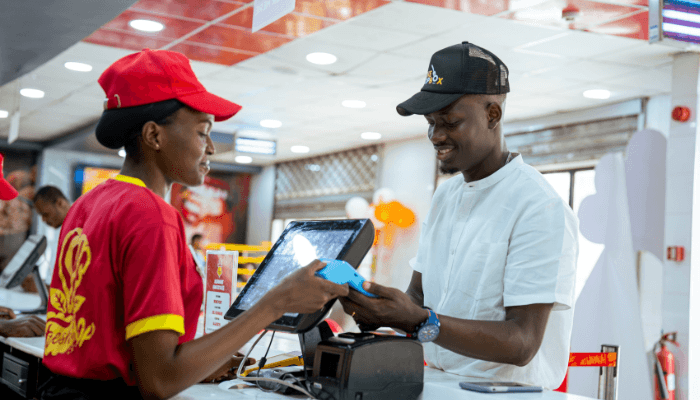
Nigeria's foodservice industry is experiencing radical change as digital payments and financial technology replace the cash-based operations that defined the sector for decades. The transformation marks the most significant shift since modern fast-food chains emerged in the 1980s.
The sector has grown into an $11.09 billion market in 2025, driven by instant payments, cloud kitchens, food delivery platforms, and integrated fintech solutions. According to a new case study by Moniepoint, the industry will reach $19.31 billion by 2030, growing at 11.73 percent annually.
Fintech companies are now moving beyond simple payment processing to provide the digital infrastructure businesses use to manage sales, inventory, lending, and day-to-day operations. For food businesses, this represents a shift from merely accepting electronic payments to operating on fully digital financial systems.
Tosin Eniolorunda, group chief executive officer of Moniepoint Inc., said the real competitive advantage lies in how deeply payment infrastructure integrates into business operations. "The real competitive question today is how deeply that payment infrastructure is woven into the way the business actually runs day to day," he told reporters.
The company connects payments to inventory management, inventory to recipes, recipes to procurement, procurement to credit facilities, and credit to growth plans. Moniepoint built tools like Moniebook and Orda to serve restaurant operators who function as mini-factories converting perishable materials into time-sensitive products.
"By building out tools that match the operational reality of these culinary entrepreneurs, we are providing the digital operating system that drives sustainable scale for Nigeria's socio-economic development," Eniolorunda said.
The transformation began when UAC opened Kingsway Rendezvous in 1973, followed by Mr Bigg's in 1986, an event widely viewed as the birth of Nigeria's modern fast-food industry. Brands like Chicken Republic, Tantalizers, and Sweet Sensation followed, while food delivery platforms and cloud kitchens created entirely new business models.
Nigeria's expanding urban population, growing middle class, longer commuting times, and increasing smartphone use have all driven demand for convenient dining and digital ordering. Today, more than 800 quick-service restaurant outlets operate across Nigeria, while online food delivery has become a $1.04 billion market.
For most of the industry's history, restaurants operated almost entirely on cash. Operators counted money manually, transported daily sales to banks, struggled to make change during rushes, and reconciled transactions outlet by outlet.
Large chains managing multiple branches faced serious operational risks as each location held its own cash balances, exposing businesses to theft and operational inefficiency.