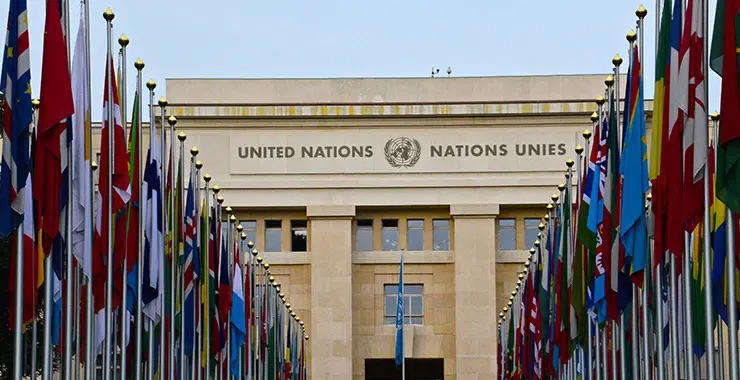
Six hopefuls will take the stage Thursday night for a rare public debate on leading the United Nations, just seven days before the Security Council formally begins picking the next secretary-general. The televised event will unfold in the General Assembly Hall, where the candidates will field 90 minutes of questions from diplomats, UN staff and civil society figures starting at 5:00 pm (2100 GMT), with Bloomberg carrying the broadcast.
The contenders are Michelle Bachelet of Chile, Ecuador's Maria Fernanda Espinosa, Argentina's Rafael Grossi, Costa Rica's Rebeca Grynspan, Carolyn Rodrigues-Birkett from Guyana, and Senegal's Macky Sall. They're all vying to replace Antonio Guterres, who is stepping down after his tenure expires.
General Assembly President Annalena Baerbock called the event "a rare opportunity to engage with the ideas, priorities and leadership vision of the candidates for one of the world's most important positions." She underscored that the UN needs "not only an exceptional chief administrator" but also someone willing to defend the UN Charter and its three core pillars.
The organization is grappling with a severe financial and trust crisis right now. US President Donald Trump's administration has lashed out at the UN for wasteful spending, spreading itself too thin, and failing to produce real results.
Washington wants the organisation to refocus on its core work in peace and security, while many other nations argue that human rights and development deserve equal weight. This tension looms over the entire selection process.
The campaign itself lacks energy compared to the 2016 race, which drew more candidates and generated considerable intrigue, according to Richard Gowan, an analyst at the International Crisis Group. "This time around everyone agrees that the race is incredibly important for the future of the UN, but the contest itself has been quite cautious," he told AFP.
Gowan noted that candidates appear to be "treading carefully to avoid offending the US and other veto powers." The six hopefuls have already sat through three hours of questioning each from representatives of all 193 UN member states.
Most have stressed the need to push through ongoing reforms to boost efficiency and strengthen the secretary-general's role in global peace efforts. On July 30, the Security Council's 15 members will conduct their first closed-door, anonymous vote to gauge their preferences among the candidates.
That opening "straw poll" will be followed by repeated voting rounds until one candidate clinches nine votes without facing a veto from any of the five permanent members. The winner's name then goes to the General Assembly for formal appointment to the post.
Whoever wins will assume office on January 1, 2027. Several diplomats who spoke to AFP remained guarded about the outcome, noting that many capitals hadn't yet settled on their choice.