
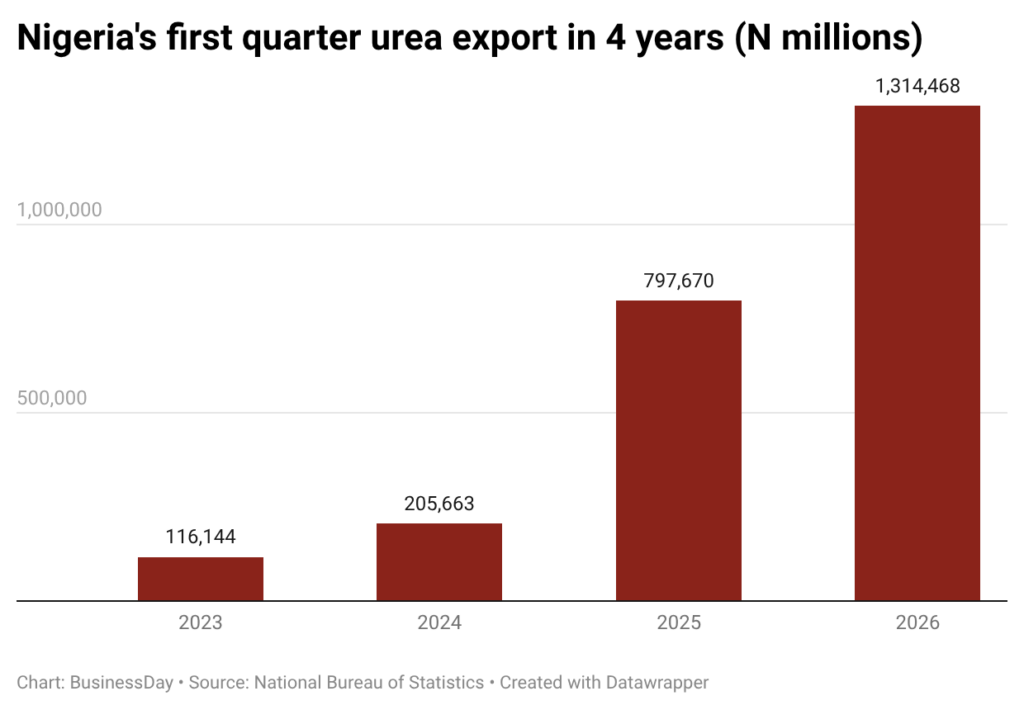
Nigeria's urea shipments jumped 64 percent in the first quarter compared to last year. The Middle East conflict has disrupted global supplies, creating a windfall for local producers.
Export revenues climbed to ₦1.3 trillion in the opening three months of 2026. That's up sharply from ₦797.7 billion in the same period last year, according to National Bureau of Statistics data.
Geopolitical tensions have effectively shut down the Strait of Hormuz. This critical shipping route normally handles 35 percent of the world's urea supplies.
With Middle Eastern production crippled, Nigerian manufacturers are racing to fill the gap. Buyers across Brazil, the United States, India, Ethiopia, and Ukraine are placing urgent orders.
Gideon Negedu, former Executive Secretary of the Fertiliser Producers and Suppliers Association of Nigeria, sees sustained growth ahead. "For our local urea industry, the current surge in demand is a boon," he told BusinessDay in an earlier conversation.
Europe's situation has worsened considerably. Gas prices there have climbed more than 20 percent since fighting erupted in the Middle East.
European nitrogen producers depend heavily on imported natural gas for manufacturing. Rising energy costs have forced many to cut production as operations become uneconomical.
This squeeze on European and Middle Eastern output has pushed global buyers toward Nigeria. Continental importers now have little choice but to seek alternatives.
An Indorama staff member confirmed a sharp rise in orders since February. Speaking anonymously, the employee noted: "We are seeing a consistent increase in orders, though we are prioritising our existing customer commitments first."
Nigeria runs three major urea plants with combined capacity of 6.5 million metric tons. Notore, Indorama, and Dangote all operate at full strength.
These facilities produced roughly 3.65 million metric tons in 2023. Current utilisation rates suggest that output will climb further this year.
Aliko Dangote credits his company's capacity with helping stabilize West, Central, and East African markets. According to him, Dangote has rerouted shipments to African nations that weren't traditional buyers before.
But the export boom has created pain at home. A 50-kilogramme bag of urea now costs ₦50,500, up 53 percent from ₦33,000 in February.
Domestic consumers are bearing the cost of global shortage. Food inflation has worsened as farmers face steeper fertiliser bills.