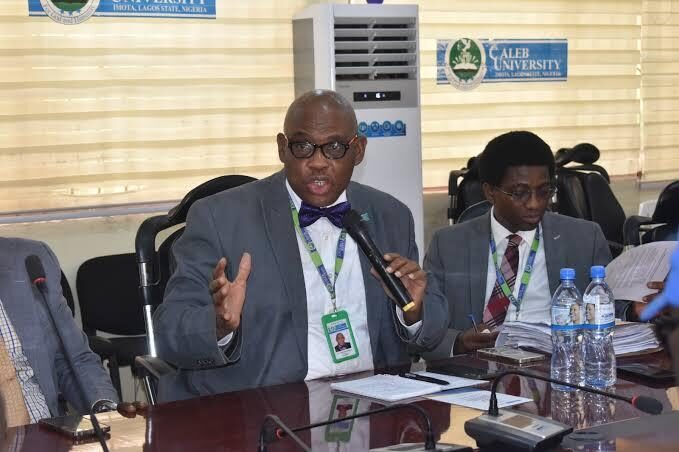
Human resources management must evolve from administrative paperwork into a strategic engine that powers innovation and business growth, speakers insisted at Caleb University's HR Space conference 2026 in Lagos. The event brought together academics, industry leaders and HR professionals to explore how people management can help Nigerian organisations survive disruption and thrive in an artificial intelligence-driven economy.
Olalekan Asikhia, vice-chancellor of Caleb University in Imota, challenged the room with a stark assessment. "The old playbook is no longer fit for purpose.
We cannot continue to manage people the way we did in the 1990s. The world has changed, the workforce has changed, and if we do not change, we will be left behind," he said.
Nigeria's businesses face a perfect storm, Asikhia explained. Economic volatility, severe talent shortages and rapid technological change are squeezing companies from all sides, he told reporters.
The solution demands urgent action on two fronts. Companies must upskill and reskill their workers now to prepare for an AI-powered future, while universities must produce graduates armed with digital, technical and leadership capabilities that employers actually need.
The traditional HR department—once focused on hiring, payroll and compliance—has become obsolete, Asikhia argued. "Is HR still relevant in the way we have practiced it over the last three decades?
The answer is clear—HR must be completely reimagined," he said.
This conference was deliberately designed as a bridge between three worlds that rarely speak to each other. Academia, industry and government policymakers needed to collaborate on practical solutions that would strengthen both organisations and the broader workforce, Asikhia explained.
Caleb University's Business School partnered with the Chartered Institute of Personnel Management of Nigeria, the Institute of Chartered Secretaries and Administrators of Nigeria, Cambridge University and Manchester University to deliver the gathering. The audience included chief human resources officers, HR directors, CEOs, chief operating officers and senior business leaders.
Repositioning HR as a strategic asset rather than a cost centre requires courage and vision, Asikhia stressed. "This is where policy meets practice.
This is where academia meets industry. This is where we forge a new path for the Nigerian workplace," he said.
Nigeria possesses genuine advantages that other nations envy, the university administrator noted. "We have the talent.
We have the intellect. We have the resources.
What we need is the collective will to reimagine HR and place it at the heart of business strategy," Asikhia said.
Caleb University's Business School and Technology Hub are already closing skills gaps by exposing students to real business challenges and building digital HR solutions, he added. The work demonstrates how universities can partner meaningfully with employers to shrink the gap between classroom learning and workplace readiness.
The future workplace won't simply arrive as a product of technological change, Asikhia insisted. "The future of work is not something we enter; it is something we create.
Let us leave this conference not merely with ideas, but with the resolve to build the workplace and the nation we desire," he said.