
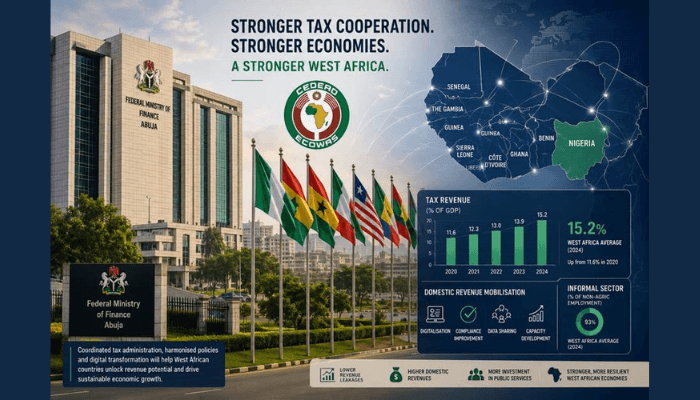
Nigeria is taking its tax reform agenda beyond national borders, pushing West African governments to strengthen coordination on tax administration. Officials argue that closer regional cooperation can plug revenue leaks, boost collections and prevent businesses from gaming differences across national tax systems.
The move reflects a pressing challenge facing African governments. Companies, money and digital services flow across borders with ease, yet tax collection remains largely national.
As trade grows under the African Continental Free Trade Area, gaps between tax rules have made it simpler for firms to shift profits, dodge taxes and exploit uneven enforcement, shrinking what governments can collect.
For Nigeria, this is more than an administrative problem now. It's become a matter of survival for government finances.
Despite sweeping tax overhauls in recent years, Nigeria still has among the world's lowest tax-to-GDP ratios. Weak revenue collection continues to squeeze spending on roads, hospitals and schools while forcing reliance on heavy borrowing to pay bills.
That's why the government is now looking outward. On July 14, finance minister Taiwo Oyedele met with leaders of the West African Tax Administration Forum in Abuja.
He told them that regional tax cooperation must shift from talking points to real action on the ground.
Oyedele pushed WATAF to create benchmarking tools and scorecards that measure how member states enforce ECOWAS tax rules. This would let governments track their own performance, spot gaps and drive better compliance across the bloc.
He also urged the body to collect and share winning strategies in digital tax systems, informal sector taxation and broader reforms so other countries can copy what works.
This signals a fundamental change in how governments now see tax reform. For decades, collecting more tax meant updating domestic laws, expanding tax offices and tightening compliance at home.
That strategy is losing steam as firms do business across multiple countries at once.
Global companies earn money in several nations while digital firms generate huge revenue without any real office presence. Without shared rules and better data sharing, tax offices can't figure out where profits should be taxed, letting money escape through cracks between countries.
Stronger regional ties would also help businesses. Companies working across ECOWAS still face different filing rules, varying requirements and inconsistent enforcement despite years of regional cooperation talk.
Better alignment would cut costs for firms, ease uncertainty and make cross-border deals more appealing.
For Nigeria, though, the real gain is at home. Each naira collected in taxes cuts government reliance on borrowing and frees up money for power plants, roads, hospitals and schools.
With debt servicing eating up resources, stronger tax revenue could reshape the budget.


