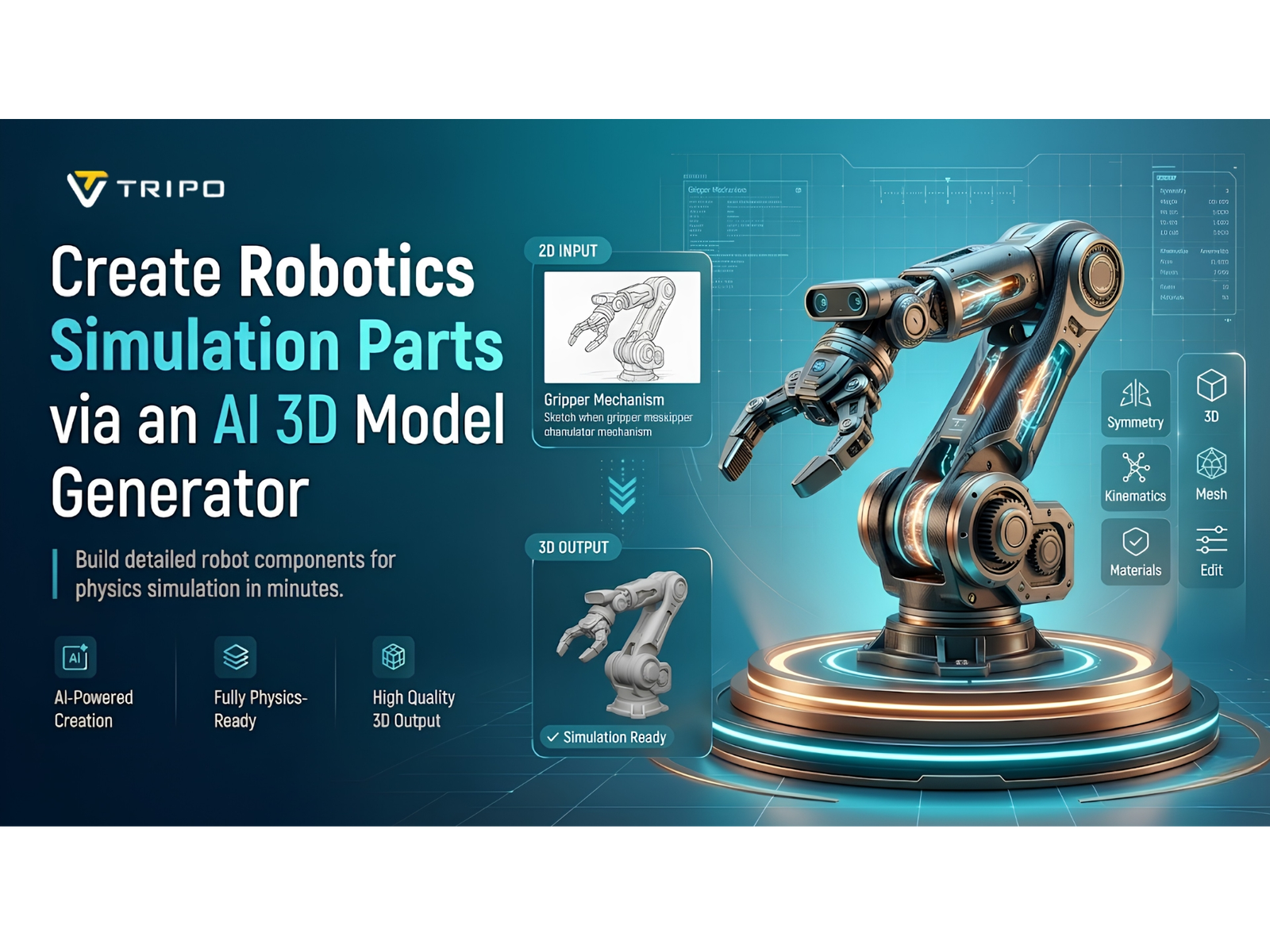
Accurate digital components are essential for reliable robotics simulations. High-quality parts enable precise motion behavior, collision detection, and proper engineering validation.
Creating 3D models by hand demands substantial expertise, specialized training, and extended timelines. Tripo 3D streamlines this work using automated tools and efficient processes.
The platform converts sketches, references, and ideas into functional assets rapidly. AI generation lets engineers develop simulation components with less manual effort while preserving structural accuracy.
Quality 3D parts form the backbone of effective robotics simulations. Detailed components create realistic virtual environments and authentic system behavior during testing.
Reliable geometry drives motion analysis and collision calculations. Models built with precision give engineers greater confidence in both simulation results and engineering outcomes.
Digital assets enable teams to validate designs before manufacturing physical prototypes. Early testing cuts risks, expenses, and design flaws during development cycles.
Tripo 3D maintains consistency across simulation resources and strengthens robotics development workflows. Modern engineering teams need faster approaches to generate simulation assets.
An AI 3D model generator transforms sketches, text prompts, or ideas into usable 3D models with minimal human input. Automated creation reduces manual modeling work and compresses development schedules.
Engineers can produce geometry for simulation testing more quickly. This enables continuous design refinement and efficient performance evaluation.
Generated asset libraries provide reusable models for multiple robotics projects. Tripo 3D creates parts efficiently with dependable geometric structure and practical usability.
The platform includes several tools designed for robotics simulation development. Text-based generation builds components from written descriptions alone.
It also offers image-to-3D workflows based on reference images and concept drawings. For engineering work, structured topology generation keeps meshes organized and logical.
High-resolution texture support improves visibility during client presentations and design reviews. Export compatibility enables smooth integration with simulation software and development tools.
These features support the creation of organized assets for iterative robotics workflows. Begin by accessing Tripo 3D and creating your account.
Navigate to the "Model" tab in the vertical left menu bar. Select "HD Model" from the options displayed.
You can generate robotic parts using text descriptions or uploaded images. Drag and drop files or click "Upload" to add images from your device.
Without an image, select the "Text to model" tab and describe your required component. Under "General settings," activate "AI complete" for automatic generation.
You can also enable textures and select your preferred "Texture Quality" level. The system will process your inputs and generate the simulation-ready component.
Review the output for accuracy and structural integrity. Download the finished model in your required format for immediate use in simulation software.