
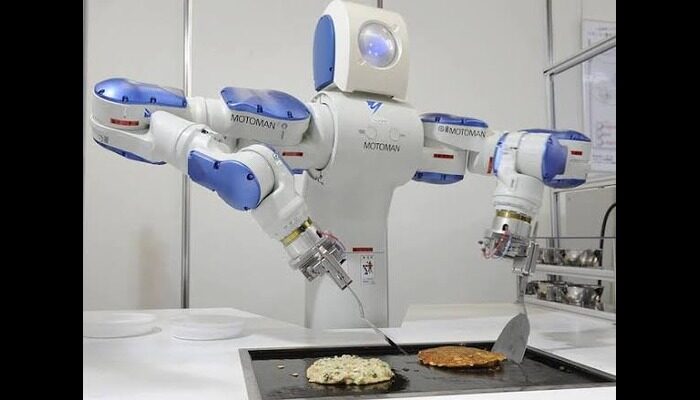
Japan's food service industry is racing to use artificial intelligence and robots to replicate the skills of master chefs, aiming to solve a deepening crisis of worker shortages and ageing staff. The deployment of AI-powered culinary machines marks a turning point as the country grapples with dwindling labour supply and the loss of traditional apprenticeship systems.
Deep learning models now analyse vast collections of images, thermal data, and movement patterns to digitise human cooking technique. The technology has reached a critical threshold where machines can learn what experienced chefs know through years of practice.
Japan's Ministry of Health, Labour and Welfare painted a stark picture of the challenge. The job-openings-to-applicants ratio in food service stands at 2.31, nearly double the national average of 1.13 across all industries.
In Kobe, confectionery manufacturer Juchheim recently opened a showroom and training facility for "Theo," a robot equipped with AI to bake baumkuchen, the multi-layered German sponge cake the company introduced to Japan in 1919. Mastering this delicate dessert traditionally took years because bakers had to constantly adjust roasting times based on temperature and humidity shifts.
Theo uses cameras and precision sensors to study how master bakers move and judge heat, then determines the best cooking conditions. The robot can learn new recipes in days.
Following its debut at the 2025 Osaka-Kansai Expo, Theo now operates in roughly 20 kitchens across the country, with plans to expand to 100 locations by year's end. Hideo Kawamoto, Juchheim's president, told reporters the technology "can greatly help the food service industry, which is facing a shortage of successor workers."
Historically, top culinary skills were locked away as "tacit knowledge"—expertise gained through watching and repetition rather than formal teaching. This secrecy gave individual kitchens competitive edges but created succession problems.
Professor Hitoshi Matsubara, an AI specialist at Kyoto Tachibana University, explained the shift: "In the pre-deep learning era, AI could not teach tacit knowledge, but as technology has advanced, it has become possible to digitise skilled workers' movements, which involve tacit knowledge."
Other developers are pursuing similar paths. Tokyo-based TechMagic built software that calculates ideal pan rotation speeds, flame levels, and timing for yakisoba and fried rice, letting robotic arms execute these complex dishes with precision.
In seafood processing, media company Dentsu launched "Tuna Scope," an algorithm trained to evaluate tuna quality from cross-sectional images. The system replicates mekiki, the expert eye for fish grading that normally requires a decade to master, and has already entered commercial use.
