
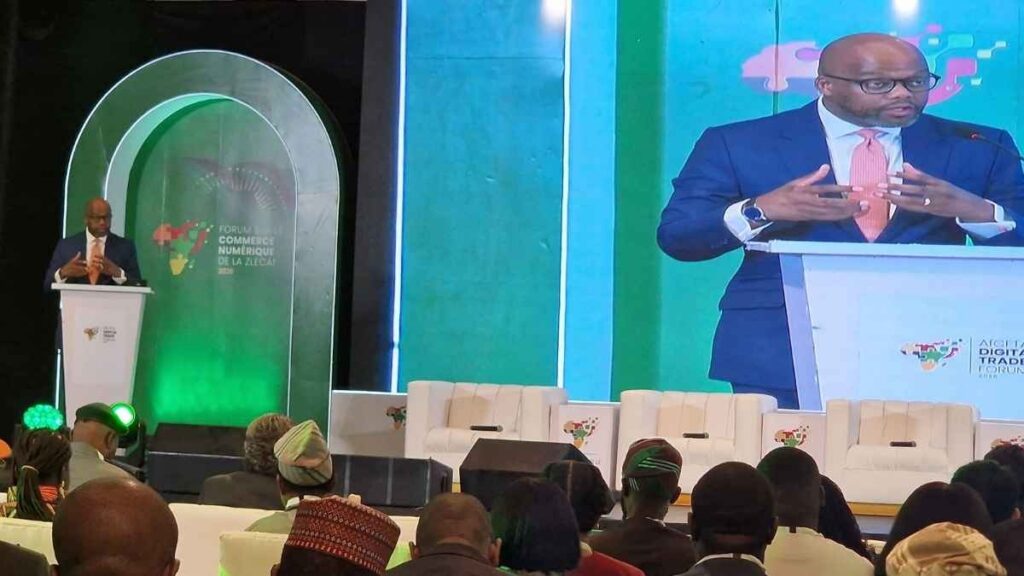
Africa needs to build more than 500 new data centres by 2035 to take control of its own digital future and compete in cross-border trade, the African Continental Free Trade Area Secretariat has said. Wamkele Mene, the secretariat's secretary-general, made this call at the AfCFTA Digital Trade Forum in Lagos.
"Our studies indicate that our continent, by the end of 2035, will require over 700 data centres to enable us to process our own data, manufacture our own data and to manage our own data," Mene said.
Current data tells a stark story. Research released by Aritzon advisory and intelligence in March 2026 found just 132 operational data centres and 57 under construction across 14 regions on the continent.
South Africa and Nigeria control nearly 80 percent of existing capacity, leaving Africa roughly 500 data centres short of what it needs. This imbalance threatens the continent's digital sovereignty.
Mene said closing this gap would unlock Africa's surging digital economy, currently valued at about $180 billion and expected to hit $700 billion by 2050. He framed data centre expansion as the continent's most pressing economic opportunity.
The numbers behind this urgency are compelling. Africa had 900 million smartphone users by 2022—more than the United States and Europe combined—and 40 percent of the world's youth will live here by 2022.
"We must harness this dividend," Mene said at the forum.
Nigeria offers a microcosm of the challenge. Datacentres.com identified 18 data centres across three states and five cities, mostly operated by 12 private sector players.
Mene told BusinessDay that while private investment has driven progress in Nigeria, greater federal backing is essential. He emphasised that government must step in where the private sector cannot.
"We need governments to invest in power generation, because as you know, these data centres consume a lot of power," he said. "So it has to be both public and private sector.
This is the best way to go."
The infrastructure challenge intersects with artificial intelligence's growing role in solving Africa's unique digital problems. Olumide Balogun, head of Google East and West Africa, highlighted language barriers as one such area.
"We're a continent of over 2,000 languages. The versatility of that is great but it does portend some disadvantages as well and we think that is an area that artificial intelligence can help," Balogun said.
He wants open datasets that let a Swahili speaker communicate with an Igbo speaker without learning the other's language—a frontier where AI could unlock enormous value.
Data centres function as the engines of the digital economy, housing the specialised hardware and computing power that train and run advanced AI models. Jumoke Oduwole, Nigeria's minister of trade and investment, noted that Africa possesses both the mineral resources needed for hardware and the energy infrastructure to power this transformation.