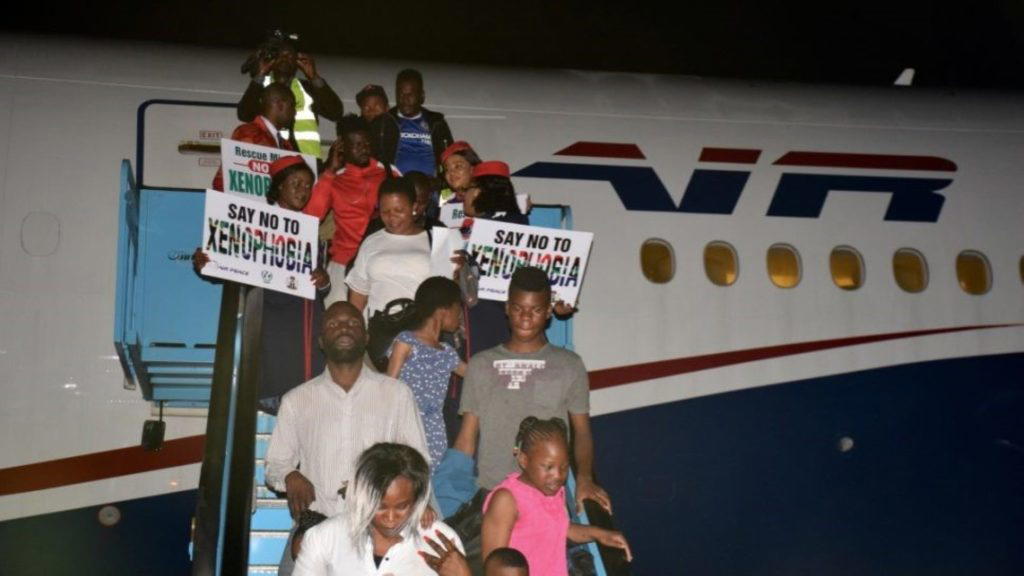
The federal government says it's backing the reintegration of Nigerians returning from South Africa with livelihood support, skills training, and mental health counselling to help them heal from their ordeals. The commitment comes as Air Peace completed its third evacuation flight from the country, bringing 268 more Nigerians home to Lagos on Friday.
Ambassador Catherine Udida, who heads the Migration Affairs Department at the National Commission for Refugees, Migrants and Internally Displaced Persons, said over 1,000 returnees have already been profiled and registered for assistance. She told reporters that multiple government agencies including NEMA, NiDcom, FAAN and the National Immigration Service are coordinating the reception effort.
According to Udida, NEMA is arranging transport to get returnees to their home states while her commission leads the overall reintegration process. "We are providing durable solutions that include livelihood support, skills training, and psychosocial counselling because of the trauma they have experienced," she said.
The official also noted that Nigeria and South Africa have held bilateral talks aimed at safeguarding Nigerians still in the country. She said these engagements have been ongoing to ensure their security and protection.
However, returnees paint a grimmer picture, describing massive financial losses and the burden of being stereotyped as criminals. Babatunde Oladeji, who spent two decades in South Africa, said he lost his security and cleaning company to what he described as hijacking.
"I lost more than 1.5 million rand. They looted me and used my details for fraudulent purposes," Oladeji told reporters.
He said the violence wasn't just xenophobia but specifically targeted at African migrants.
Oladeji explained that he watched foreign nationals from Western countries move freely without harassment while Africans faced constant attacks. "They only have problems with African migrants.
I saw Americans who were there on visits, but they never had such experiences," he said.
The businessman revealed that he lost his home, his business, and nearly everything he'd built over two decades. He now finds himself back in Nigeria with no clear path forward and struggling to support his family.
Oladeji stressed that he wasn't an undocumented migrant, yet he and other Nigerians were treated as criminals regardless of their status. "The perception they have of Nigerians is terrible; they see every Nigerian as a criminal," he added.
His story reflects a broader pattern among returnees, many of whom have lost significant investments and property. The trauma extends beyond financial ruin to the psychological toll of discrimination and targeted violence.
The government's promise of counselling and skills training represents an attempt to address these challenges, though returnees face the immediate hurdle of rebuilding their lives from scratch. For Oladeji and thousands like him, the road to recovery remains steep and uncertain.