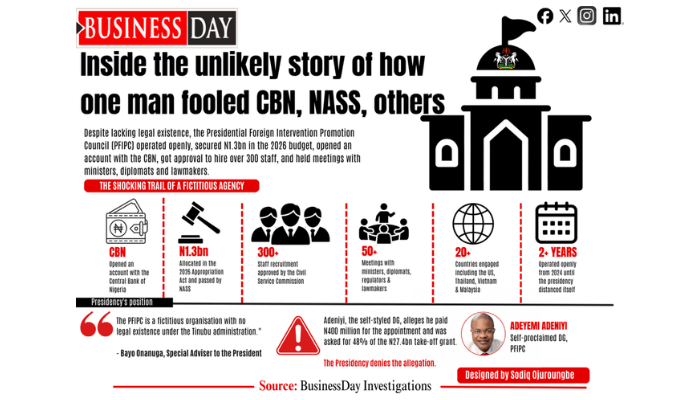
The Presidency has stated that the Presidential Foreign Intervention Promotion Council never legally existed. Yet records show the council secured a N1.3 billion budget allocation, operated bank accounts with the Central Bank of Nigeria, obtained approval to hire more than 300 staff members and convened meetings with ministers, diplomats and lawmakers.
Using official documents, interviews and publicly available information, investigators have traced how a supposedly fictitious agency became woven into Nigeria's government machinery. One man managed to bypass the checks and balances of the National Assembly, the verification processes of the CBN and oversight mechanisms within the federal bureaucracy.
For nearly two years, Adeyemi Adeniyi operated openly in Abuja as director-general of both the Presidential Economic Advisory Council and the Presidential Foreign Intervention Promotion Council. He met with ambassadors, organised conferences, attended official government functions and engaged with senior officials much like the heads of other federal agencies.
On June 11, the Presidency publicly disowned the council. The Office of the Chief of Staff and the Presidency both described the PFIPC as a fictitious organisation with no legal standing under President Bola Tinubu's administration.
The declaration raised an uncomfortable question: if PFIPC never existed, how did it obtain a budget allocation, secure a CBN account, win approval to employ more than 300 people and gain recognition from multiple government bodies?
Nigeria's 2026 budget, passed by the National Assembly after a four-month review, included the council on page 4 of the 2,790-page Appropriation Act. The PEAC and PFIPC appeared immediately below the National Council on Climate Change, which was formally established under Nigeria's Climate Change Act of 2021.
The council received a total budgetary allocation of N1.3 billion under Budget Code 0111062001. Placed under the Presidency's umbrella, the allocation covered personnel costs of N802.9 million, overhead spending of N200 million and capital projects valued at N300 million.
The council went through standard verification procedures before being included in the budget. The Federal Executive Council reviews spending estimates, the Budget Office consolidates proposals and the National Assembly conducts public hearings and committee defence sessions.
Between February 2 and 13, 2026, the Senate Committee on Appropriations, chaired by Solomon Adeola, held budget defence sessions with all ministries, departments and agencies. Adeola publicly warned that all MDAs must appear before their respective committees to defend their budget proposals or face consequences.
Yet somehow, the council that the Presidency now describes as fictitious passed through every layer of scrutiny and received official recognition across Nigeria's government institutions.